
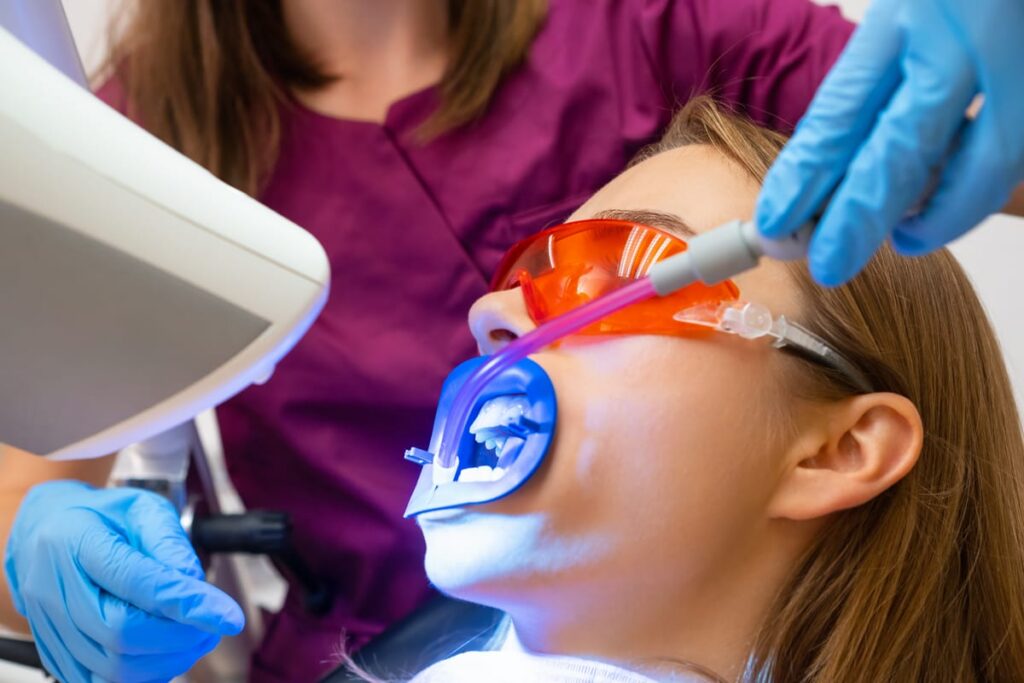
Not everyone gets the same results from teeth whitening. Some patients walk away with dramatically brighter smiles. Others see little change at all. If you live in Missouri City and you’re wondering, Will Your Teeth Actually Whiten? A Self-Screening Guide Missouri City residents can use is a great place to start. Understanding your candidacy before spending money on treatment saves frustration and sets realistic expectations.
Dr. Andrew Nguyen at Excel Dental wants every patient to make informed decisions. That starts with knowing how whitening actually works — and why it works differently for different people.
How Teeth Whitening Works in Missouri City
Whitening products use peroxide-based agents to break up stain molecules inside tooth enamel. The bleaching agent penetrates the outer layer and lightens the underlying dentin. This process works beautifully on certain types of stains. It does almost nothing on others.
There are two main stain categories: extrinsic and intrinsic. Extrinsic stains sit on the surface of the tooth. Intrinsic stains live deep inside the tooth structure. Whitening treatments target extrinsic stains most effectively. Intrinsic stains are far more resistant to bleaching agents.
Knowing which type you have is the first step in your self-screening process. A quick dental exam at Excel Dental can confirm this within minutes.
Who Gets the Best Whitening Results? Self-Screening in Missouri City
Whitening works best for patients with healthy, natural teeth and surface-level staining. If your teeth are yellowed from coffee, tea, red wine, or tobacco, you are likely a strong candidate. These are classic extrinsic stains that respond well to peroxide treatments.
Here are the characteristics of ideal whitening candidates:
- Natural teeth without crowns, veneers, or bonding in the smile zone
- Yellow or light brown surface staining from food and drinks
- Good overall oral health with no active cavities or gum disease
- No history of severe tooth sensitivity
- Realistic expectations about the degree of whitening possible
If you check most of these boxes, professional whitening is likely worth exploring. A consultation with Dr. Nguyen can confirm your candidacy quickly and safely.
Who May NOT See Results — And Why
This is where honest patient education matters most. Certain conditions make whitening far less effective or even inappropriate. Understanding these limitations protects your wallet and your smile.
Crowns and Veneers: Dental restorations do not whiten. Porcelain crowns, Crowns Bridges Missouri City patients rely on, and veneers are made from materials that resist bleaching agents entirely. If you whiten your natural teeth, the restorations stay the same shade. This creates a visible mismatch in your smile.
Intrinsic Staining: Some stains form inside the tooth itself during development. These do not respond to surface whitening. They require cosmetic solutions like veneers or bonding.
Medication-Induced Staining: Tetracycline antibiotics taken during childhood can cause deep gray or brown banding inside teeth. This type of staining is notoriously difficult to treat with whitening alone. Results are often minimal, and multiple sessions rarely produce significant change.
Fluorosis: Excessive fluoride during tooth development can create white spots or brown patches. Whitening may actually make these spots more pronounced rather than blending them in.
Here are other factors that may limit your whitening results:
- Teeth with multiple large fillings in the front of the mouth
- Severely worn or thinned enamel
- Active untreated tooth decay
- Gum disease or significant gum recession
- Underlying nerve damage requiring Root Canals Missouri City treatment
None of these mean you cannot have a beautiful smile. It simply means whitening alone may not be the right tool for your situation.
Your At-Home Self-Screening Checklist
Before your consultation, run through this quick self-check. It helps you arrive prepared with the right questions for Dr. Nguyen.
Step 1 — Identify your stain type. Are your teeth uniformly yellow or stained from lifestyle habits? Likely extrinsic. Are the stains gray, banded, or spotted? Possibly intrinsic.
Step 2 — Check your existing dental work. Look at your smile in a mirror. Do you have crowns, bridges, veneers, or bonding on visible teeth? If yes, whitening will not change those restorations.
Step 3 — Review your medication history. Did you take tetracycline or related antibiotics as a child? Talk to Dr. Nguyen about alternative cosmetic options.
Step 4 — Assess your oral health. Do your gums bleed when you brush? Do you have tooth pain or sensitivity? These issues need to be addressed before any whitening treatment begins.
Step 5 — Set realistic expectations. Even ideal candidates rarely go from stained to blindingly white in one session. Professional whitening can lighten teeth several shades. It produces natural-looking results, not artificial-looking ones.
Professional Whitening vs. Over-the-Counter Products
Missouri City residents have no shortage of whitening options at the pharmacy. Strips, trays, toothpastes, and pens all promise brighter smiles. These products contain much lower concentrations of whitening agents than professional treatments.
Over-the-counter products work for very mild surface staining. They rarely produce significant results for moderate to heavy staining. They also carry a higher risk of uneven application and sensitivity when used without guidance.
Professional whitening at Excel Dental uses custom-fitted trays and prescription-strength gel. Dr. Nguyen monitors the process to minimize sensitivity and maximize even coverage. The difference in outcomes is usually significant.
For patients who are not ideal whitening candidates, Dr. Nguyen can discuss cosmetic alternatives. These may include porcelain veneers, dental bonding, or other options tailored to your specific smile goals.
Frequently Asked Questions
Can I whiten my teeth if I have sensitive teeth?
Sensitivity does not automatically disqualify you from whitening. Dr. Nguyen may recommend a lower-concentration gel or desensitizing treatments before and after whitening. Many patients with mild sensitivity complete whitening comfortably with the right protocol in place.
How long does professional teeth whitening last?
Results typically last one to three years depending on your lifestyle habits. Avoiding coffee, tea, red wine, and tobacco extends results significantly. Occasional touch-up treatments help maintain your shade between full whitening sessions.
Will whitening work on a single dark tooth?
A single dark tooth is often a sign of internal discoloration, sometimes related to past trauma or nerve damage. Standard whitening treatments are unlikely to correct this. Internal bleaching or a porcelain crown may be more appropriate options depending on the cause.
Is teeth whitening safe for everyone?
Whitening is safe for most healthy adults when performed correctly. It is not recommended for children, pregnant women, or patients with untreated cavities and gum disease. A proper exam at Excel Dental ensures whitening is appropriate and safe for your specific situation.
What if whitening does not work for me?
Not achieving whitening results does not mean you are stuck with your current smile. Dr. Nguyen offers several cosmetic and restorative options to address discoloration through alternative means. A personalized consultation helps identify the most effective path forward for your unique smile.
Understanding your candidacy is the smartest first step toward a brighter smile. Dr. Andrew Nguyen and the team at Missouri City Dentist – Excel Dental are ready to help you find out exactly what your smile can achieve. Book Now to schedule your appointment with our team.